Tablets, smart phones, TVs, laptops, computers and computer games consoles are everywhere and most of us couldn’t do without them! Screen time can be fun and helpful for learning. Screen time can cause problems too.
What is screen time?
Screen time is any time when your baby, toddler, child or young person looks at a screen. Screen time also includes when a screen is on in the background, even when your child or young person doesn't seem to be watching them.
How can screen time be harmful?
Screen time can affect your child's development. Studies show that children who use screens more often achieve less than their peers. Infant screen use impacts on learning and development into later childhood. It might even impact into adulthood. High screen time can lead to:
poor motor skills
poor language processing
poor problem solving
delayed social development
difficulties with concentration
issues with sleep
poor mental health
Children learn best by talking with adults, looking at faces, playing and exploring. The more opportunities babies and children have to interact with an interested adult, the more opportunities there are to develop language and communication. So, too much screen time can limit the amount of interactive time a child has with an adult and this has an impact on the amount of talk they can hear and join in with.
Screen time can also limit the amount of time a child/young person has for other types of activities that help to keep them healthy. It's important to have a balance between screen free play, exercise, creativity, quiet time and time outdoors.
What about adults use of devices?
Adult screen time can also affect your child's development. This is because you are less tuned into your child and their needs when using your phone or other screens.
Safer Screen Time
Under 2 years
Try to avoid screen time altogether
Screens should only be used together with an adult for interacting with others (video calling family).
2-5 years
Try to keep screen time to no more than one hour a day.
Avoid screen time at mealtimes and in the hour before bed.
When using screens
choose calm, slow programmes
choose content for your child's age
avoid fast videos and social media clips
avoid AI toys or tools
watch or play together
talk about what you see and do.
School aged children
For older children and young people, think about how screens are used rather than just how long.
Try to keep screen time to no more than two hours a day.
Avoid screen time at mealtimes and in the hour before bed.
When using screens
choose high quality programmes
choose content for your child's age
avoid social media before they are 16 years old
focus on video calling friends and family and doing research for school/homework
turn off auto play on YouTube Kids / YouTube
you should be able to see what they are doing
watch or play together
talk about what you see and do.
Screen use is a problem if it:
affects sleep
gets in the way of school work
causes stress or affects mood
stops family time.
If screen use is becoming a problem, try to help your child/young person to make time for:
playing offline
being active
being creative
spending time outdoors
family activities
activities with friends.
What you can do at home
Watch or play together
Talk about what they are doing online and during screen time
Know what your child is doing and who they are talking to online
Set clear rules about screen time
Keep bedrooms screen free
Use parental controls to limit access
Turn screens off when not being used
Have screen free times, like mealtimes and for at least an hour before bedtime
Charge devices in shared spaces not in bedrooms
Teach your child about online safety and kindness
Try out any activities or apps before you let your child loose on them to make sure they are appropriate
When your young person is ready for social media, teach them about safety and privacy. It is important that teenagers are aware that everything they post online is not private, regardless of their privacy settings. Help them to understand that there are consequences of posting on-line.
Be a good digital role model
Think about your screen behaviour. Do you have a balance of activities? Is your digital use affecting your sleep, mood or health?
Put your phone away during play and mealtimes
Talk to your child during every day activities
Follow the same screen rules as your child.
We know that reducing screen time is hard for both children and adults. Pick one thing to work on. One small change can make a big difference. Be kind to yourself and your child.
Other things to think about
Emotional Development
Teach them about their feelings.
Help them to find ways to calm themselves. They could try deep breathing, talking to someone they trust or having quiet time. Look at our emotional development page for more information and ideas.
Teach them ways to notice if their screen time is having a negative affect on their health, sleep, behaviour or school work.
Posture
Make sure that they take regular breaks.
Encourage your child to use different positions, they can lie down, sit on the floor, at a table or on the sofa.
Try propping their device up nearer eye level.
If they are using a laptop or PC then think about how they are sitting.
Mind Yer Time from Children's Parliament and the Scottish Youth Parliament
Common Sense Media can help you to decide if games, movies, apps and other online content are age appropriate.
Editorial Information
Last reviewed:
11/05/2026
Next review date:
31/05/2027
Author(s):
Occupational Therapists, Paediatricians, Speech and Language Therapists, Specialist Children's Services.
Approved By:
KIDS Content Group, SCS Clinical Governance Executive Group
Reviewer name(s):
KIDS Content Group.
We are one of the leading paediatric care centres in the UK, and the largest in Scotland. We provide family centred care to newborns, infants, children and young people both in hospital and in the community.



 KIDS for Families

 Tablets, smart phones, TVs, laptops, computers and computer games consoles are everywhere and most of us couldn’t do without them! Screen time can be fun and helpful for learning. Screen time can cause problems too.
 What is screen time?
 Under 2 years
 When using screens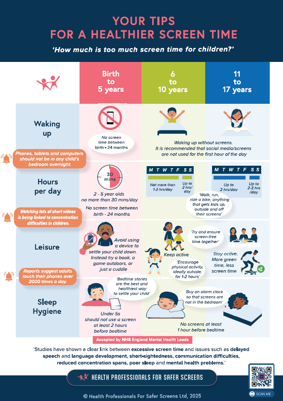
 Watch or play together
 Teach your child about online safety and kindness
 Make sure that they take regular breaks.